Encounters with Law Enforcement
This page provides information about your rights during an encounter with law enforcement agents.
The content on this website is provided for general informational purposes only and should not be considered legal advice. Using this site does not create an attorney-client relationship. For guidance on your specific situation, please consult a qualified lawyer before taking any action.
The local police force in New York City is the New York City Police Department (NYPD). Below you will find information on your rights during encounters with the NYPD.
Finding Legal Representation 🔗
To get help with a local criminal case in New York City, you can contact public defense organizations that provide free legal representation to people who are unable to afford an attorney.
NYC Public Defense Offices:
The Legal Aid Society (212) 577-3300
The Bronx Defenders (347) 778-1266
Brooklyn Defender Services Brooklyn: (718) 254-0700; Queens: (718) 261-3047
New York County Defender Services (212) 803-5100
Neighborhood Defender Service of Harlem (212) 876-5500
Know You Rights: Immigrants and the Criminal Legal System in New York 🔗
The content below is provided by Brooklyn Defender Services, last updated December 2025.
Be Prepared. You Have Rights.
Immigrants in New York have important rights when interacting with police and the criminal legal system. Here’s what you need to know:
If you are arrested by NYPD
Right to Remain Silent
Do not speak to police about your immigration status. Clearly state: “I am exercising my right to remain silent.”
- Only give your name and address.
- Do not provide your country of birth or citizenship/nationality.
- Do not lie or provide incorrect information.
- Say only: “I won’t answer any more questions until I have a lawyer” then stay silent.
- Do not answer any questions or sign any documents without your lawyer present.
NYPD and Immigration Status
Police are not supposed to ask about your immigration status unless it is relevant to their investigation. But they will ask for identification to verify who you are.
Right to a Free Lawyer in Criminal Court
You have the right to have a lawyer to defend you in your criminal case. If you cannot afford a lawyer, one will be appointed to defend you in your criminal case.
When you are brought in front of the criminal judge (this is called arraignment), the court will determine if you qualify for a free lawyer based on your financial situation. If you do, a lawyer will be appointed to represent you.
When You Meet Your Criminal Defense Lawyer
While in jail, do not speak with anyone about your case or immigration status, except your lawyer. To make sure you are speaking with your lawyer, ask:
- “Are you my lawyer?”
- To see your lawyer's ID
- “Is this conversation confidential?”
- “How will my criminal case affect my immigration status (or ability to get status)?”
Inform Your Lawyer (And No One Else) If You Were Not Born In The U.S.
A criminal case may impact the outcome of your immigration case. Your lawyer will work with you to protect your rights.
What to Do If Your Rights Have Been Violated 🔗
Police encounters can be frightening and they have the potential to escalate. The most important aspect of the encounter is your safety so stay in control and remember to exercise your rights. You have the right to be free of searches, to remain silent, and to ask for your lawyer—learn about your rights so you can be empowered. If you feel your rights have been violated, you can file a complaint with the Civilian Complaint Review Board (CCRB) online or by calling 800-341-2272.
What should I do when I'm stopped by the police?
Being respectful, calm, and avoiding arguing are the most important things to remember when stopped by an officer. Keep your hands where they can be seen by the police officers and do not run. Also, it’s good to try and memorize the police officers’ names.
If you’re stopped in your car, place your hands on the steering wheel as the police approach. Show the officer your driver’s license, registration,There are several government agencies that review complaints against the NYPD. Anyone can file a complaint by contacting Civilian Complaint Review Board and proof of insurance upon request. In certain cases, your car can be searched without a warrant, so to protect yourself later, you should state that you do not consent to a search. It’s unlawful for an officer to arrest you for refusing to consent to a search. If you’re asked to sign a ticket, sign it. You can always fight it later. And if you are suspected of drunk driving, you will be asked to take a breath-alcohol and coordination test. If you fail or refuse to take the test, you will be arrested. Also, your license may be suspended, and your car may be impounded.
Your Rights, Your Power
The Legal Aid Society’s Community Justice Unit recently launched the Your Rights, Your Power campaign to empower New Yorkers during police encounters. It includes things to remember that can keep you safe in the moment, and ready to fight with your rights when it’s done.
What if I've been mistreated by the police?
If you are a defendant in a criminal case, you must discuss with a criminal attorney any action you might consider taking in connection with your mistreatment by the police.
There are several government agencies that review complaints against the N.Y.P.D. Anyone can file a complaint by contacting Civilian Complaint Review Board (CCRB):
Civilian Complaint Review Board
40 Rector St. 2nd Floor
New York NY 10006
Phone: 212-442-8833
CCRB complaints may be filed in person, by telephone, or by mail. Complaint forms are available at all New York City police stations. The CCRB has authority to investigate and to recommend departmental action against officers engaging in excessive force, abuse of authority, discourtesy, and offensive language.
Complaints about stealing, bribe receiving or “moonlighting” by police should be referred to the NYPD Internal Affairs Division (IAD) by calling 800-PRIDE-PD, or 212-741-8401. Complaints can also be made in person at:
Internal Affairs Division
315 Hudson Street, 3rd floor
New York, NY 10013
Recurrent discriminatory practices at the precinct level should be referred to the State Attorney General, Civil Rights Bureau at 212-416-8000 or by writing to:
New York State Attorney General
Civil Rights Bureau
120 Broadway, 25th floor
New York, NY 10271
It’s important to remember that if you are a criminal defendant, or if you, a friend or a relative has been seriously injured by the police, you should consult an attorney before making a complaint to any government agency. Your statement to the government agency may be used against you in your criminal case, or may hurt your chances of winning a civil case. We strongly advise against initiating a civilian complaint on your own while a criminal or civil action is pending. The officer you are complaining about will be shown your CCRB complaint against him before your case is presented in court. Both the CCRB and the IAD will accept a complaint that is filed by your lawyer, and postpone taking your statement until your case is over.
How can I find a lawyer for a mistreatment case?
Both the CCRB and the IAD will accept a complaint that is filed by your lawyer, and postpone taking your statement until your case is over.
The New York City Policing Roundtable 212-244-4664 can provide you with the names of a number of experienced attorneys who specialize in cases involving police abuse and civil rights violations.
More Resources About the Police
Below you will find information on your rights during encounters with immigration enforcement agents.
Finding Legal Representation 🔗
New York residents who have been detained by ICE may qualify for an attorney through one of these programs:
The New York Immigrant Family Unity Project (NYIFUP)
NYIFUP accepts referrals for unrepresented people detained by ICE:
- Who cannot afford an attorney, AND
- Who have a deportation case before an immigration court located in NYC, OR
- NYC residents who have a deportation case before an immigration court in New Jersey.
If NYIFUP can accept the referral, a representative from one of the NYIFUP offices will be in touch with you. Please note that due to high demand, there are no guarantees that filling out the form will ensure legal representation. Please complete the referral form in its entirety with as many details as possible.
The Rapid Response Legal Collaborative (RRLC)
RRLC provides legal assistance to people detained by ICE or at imminent risk of detention and deportation who may not have the right to see an immigration judge or are otherwise facing a fast-track to removal.
If RRLC can accept the referral, a representative from one of the RRLC offices will be in touch with you. Please note that due to high demand, there are no guarantees that filling out the form will ensure legal representation. Please complete the referral form in its entirety with as many details as possible.
Understanding Your Rights with ICE & Immigration Enforcement 🔗
You should become familiar with your rights during an encounter with ICE and other federal immigration enforcement agents. Visit www.WeHaveRights.us for video guidance about encounters with ICE.
ICE Ruses
To learn more about tactics often used by federal agents doing immigration enforcement in communities, visit this resource from the Immigrant Defense Project: ICE Ruses resource page (updated December 2024).
Understanding Warrants
Officers must have a warrant signed by a judge to enter your home. It is important to understand the differences between a warrant and other documents that immigration enforcement officers may rely on as part of their tactics to exercise your rights in an informed manner. To learn more, visit this resource from the National Immigration Law Center, Warrants & Subpoenas: What to Look Out for and How to Respond (updated Jan 28, 2025).
What You Need to Know if a Loved One is Detained by ICE 🔗
Many noncitizen New Yorkers are being detained every day by Immigration and Customs Enforcement (ICE), even when they are going to scheduled Immigration Court hearings or other immigration-related appointments.
What happens after detention?
Where will my loved one be detained?
As a federal agency, ICE can detain non-citizens anywhere in the United States. ICE is not required to detain someone close to where they live, where they initially were detained, or where their family, loved ones, or attorney might live. Currently, ICE detains most New Yorkers in these facilities:
- Orange County Correctional Facility (aka Orange County Jail) in the Hudson Valley in Goshen, NY
- Metropolitan Detention Center in Brooklyn, NY
- Delaney Hall in Newark, New Jersey
- Moshannon Valley Processing Center in western Pennsylvania
- Various facilities in Texas and Louisiana.
Please note that your loved one may be detained initially in New York City at 26 Federal Plaza, or the immediate area, for several days before they are transferred to another ICE-contracted facility.
You can find more details about a specific ICE facility, including about visiting rules and how to send letters to a detainee, here.
Does my detained loved one have the right to an attorney in ICE detention?
While federal immigration law allows a non-citizen to have an attorney, there is no right to have an attorney appointed to you. Unlike in the criminal courts, there is no equivalent of a public defender system in the immigration courts.
Please beware of any attorney who promises an outcome in an Immigration Court or for any immigration-related matter. Immigration law and practice is complex and ever-evolving in this current federal administration.
How can my loved one get out of ICE detention quickly?
Whether someone can be released from ICE custody is dependent on their immigration or arrest history. Some people may be eligible for release during their Immigration Court case with an “immigration bond,” which usually involves paying money to the federal government as collateral for promising to continue to appear for your Immigration Court hearings.
For some people detained in NY and NJ, the Envision Freedom Fund can help pay immigration bond fees.
Currently, ICE and the Immigration Courts are increasingly denying people the option of paying an immigration bond. Sometimes they say the person is not eligible for bond at all and must fight any Immigration Court case while in detention.
Separate from an immigration “bond,” some people may also be able to ask for release from immigration custody by filing a writ of habeas corpus, if they are being unlawfully detained. This is filed in federal district court, generally where the detained person is being held. This is a complicated legal filing that involves saying the federal government violated the law by detaining someone. It is highly recommended that you consult an attorney with experience with these kinds of cases to consider your options.
It is important to note that, even if you may be able to pursue a habeas case, you may need to also proceed with your underlying Immigration Court case while in detention.
What should I do now?
Be prepared to get a call from a detention center
Once someone is detained by ICE, they will be allowed to make a phone call to a family member or friend. They are only permitted to make collect calls so you will need to accept the call, even though it is an unknown number. The detained person will not be able to leave a message if you do not answer the call.
Some of the ICE detention facilities give detained people access to a tablet that they can use to call or text. The app that is used is called “Getting Out” and requires someone to put money in the account for it to work. Not all detention centers use this but if they do, they will provide you with this link.
Please be aware that any calls to you or other non-legal calls may be monitored and/or recorded.
When someone is detained by ICE, they will need money in their commissary to be able to purchase items they may need. Every detention center has a different way to set up an account to send someone money. Once you know where the person is detained, please check this webpage for information about a specific detention center.
Confirm basic information and immigration history
Confirm this basic information about the detained loved one:
- First and Last Name(s) as listed in any immigration documents
- Country of Birth
- Date of Birth
Know their A Number, or Alien Registration Number
This is the immigration identification number for an individual. It should be listed on any immigration related document as an eight- or nine-digit number with an “A” in front of it, for example: “A22-222-222” or ”A222-222-222.” Knowing this A Number will make it much easier to search for information about your loved one.
Check if your detained loved one has an upcoming Immigration Court hearing or what the status is of a prior Immigration Court hearing.
Go to the EOIR Automated Case Information website to get this information. Enter the A Number and country of nationality in the boxes.
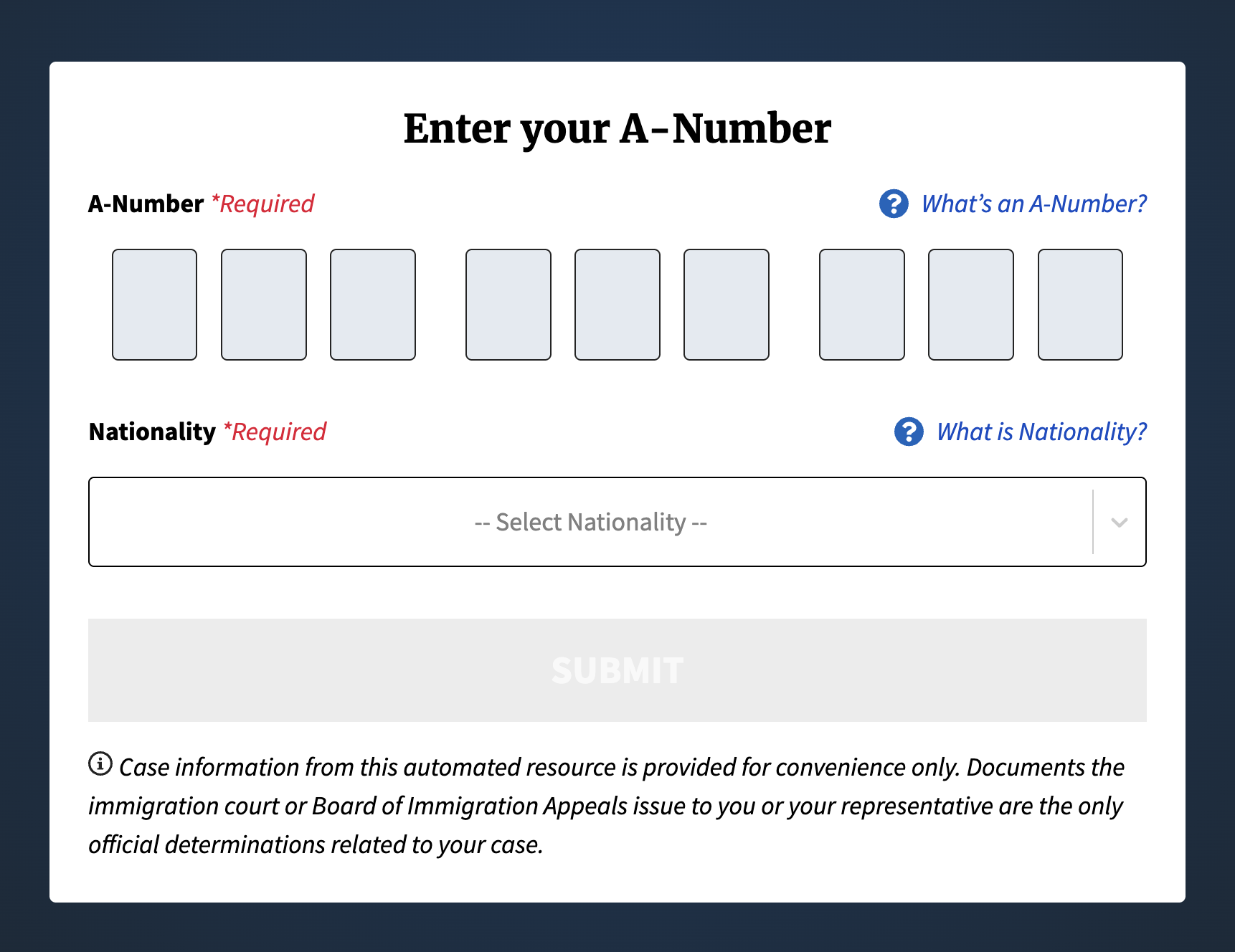
You can also call 800-898-7180 to access this system telephonically and follow the directions, in English or Spanish.
Monitor your detained loved one’s location
You can use the ICE Detainee Locator to find out where your loved one is being detained. You can search with first name, last name (as listed in any immigration documents), and country of birth, or instead with their A Number and country of birth.
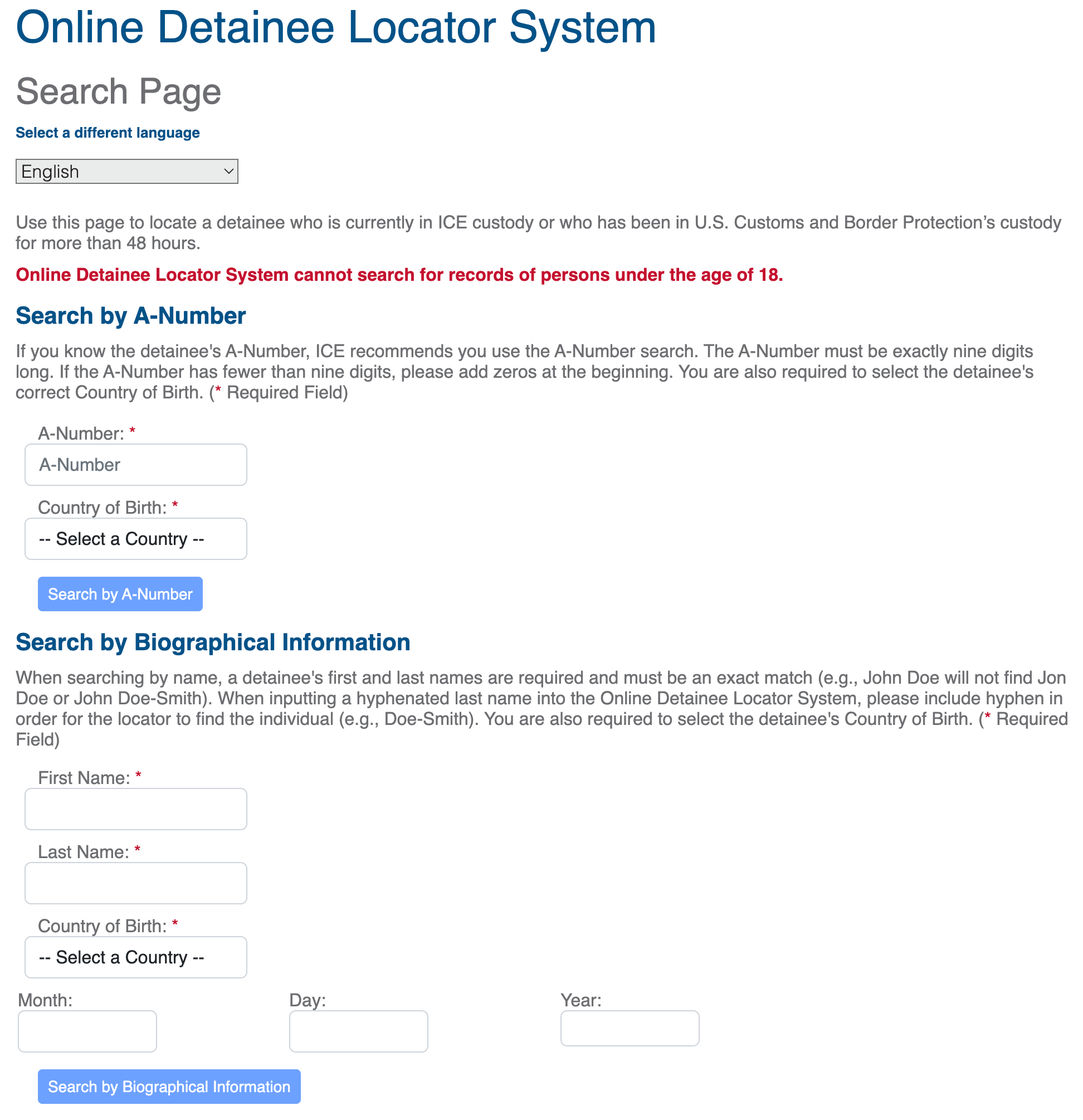
Please note that it can take a couple days after someone is arrested by ICE before this ICE locator system is updated.
Collect important documents
This may be important for any immigration attorney who may assist your detained loved one, or to otherwise advocate for them. Important documents might include government-issued IDs, medical and health documents, and legal documents (such as filed immigration applications).
Refer for immigration legal assistance
Your detained loved one may be eligible for a free attorney through the New York Immigrant Family Unity Project (NYIFUP). This project is a collaboration between three organizations: The Legal Aid Society, The Bronx Defenders, and Brooklyn Defender Services. NYIFUP provides free representation for detained New Yorkers in the New York City area.
NYIFUP may be able to assist individuals detained by ICE in these circumstances:
- Your loved one is detained by ICE and they are going to immigration court at Varick Street in Manhattan or any other immigration court in NYC, or
- They are detained by ICE and going to immigration court in Elizabeth or Newark, New Jersey (may be detained at the Moshannon Valley Processing Center) AND were residing in one of the 5 boroughs of New York City before being detained.
If the person does not meet the above criteria, please reach out to non-profit immigration legal providers here.
Please know that it may take a few weeks before your loved one appears before an Immigration Court judge after an ICE detention. In the meantime, you can submit a referral to NYIFUP.
We monitor the form and aim to reach out to the detainee within two weeks to screen for representation.
Translations
This resource has been manually translated and is available for download in Arabic, English, French, Russian, Simplified Chinese, and Spanish.
Below you will find information on your rights during encounters with federal criminal law enforcement agents, including the FBI.
Finding Legal Representation 🔗
To get help with a federal criminal case in New York City, contact the Federal Defenders of New York who provide free legal representation to people who are unable to afford an attorney.
Federal Defenders of New York, Southern District of New York (Manhattan and Bronx)
212-417-8700
Federal Defenders of New York, Eastern District of New York (Brooklyn, Queens, and Staten Island)
718-330-1200
About the Federal Criminal Legal System 🔗
Pre-arrest and Arrest Warrant FAQs
Federal agents want to talk to me. What should I do?
If you think you might be the subject of a federal investigation, you should contact a criminal defense attorney before speaking with law enforcement agents or their representatives. You have a right to an attorney’s advice and counsel in any conversation with law enforcement agents. Your attorney should arrange all meetings or telephone contact with them. Even if you do not have an attorney, remind law enforcement representatives that you wish to have an attorney present. If you cannot afford an attorney, you should contact the Federal Public Defenders Office at 212-417-8700 in Manhattan or the Bronx or 718-330-1200 in Brooklyn, Queens, and Staten Island. A Federal Public Defender will help you complete a financial affidavit to determine your eligibility for appointed counsel. This affidavit will accompany your request asking the court to provide you an attorney at no cost. Even if you believe you are only a witness in a federal investigation, you still have the option and the right to consult with an attorney and to refuse to speak with law enforcement.
I was served with a subpoena to testify before a grand jury. What do I do?
It is important to determine whether you are the subject of the grand jury investigation or just a witness providing evidence. The “subject” or “target” is anybody whom the government might charge with a crime as a result of the grand jury proceedings. Check the subpoena or your letter from the U.S. Attorney to see whether that office considers you a “subject” or “target” of the investigation. If you are the “subject” or “target” – or even if you are uncertain but suspect you might be the “subject” or “target” of the grand jury investigation – you should contact a criminal defense attorney immediately. You should not negotiate with the prosecutors or law enforcement agents by yourself. Have your defense attorney call the U.S. Attorney’s Office to identify the government’s interest in you. A criminal defense attorney can protect important rights for you, including your right against self-incrimination, and may be able to successfully negotiate immunity in exchange for your testimony.
If you cannot afford an attorney, you should contact the Federal Public Defender’s Office at 212-417-8700 in Manhattan or 718-330-1200 in Brooklyn. A Federal Public Defender will help you complete a financial affidavit to determine your eligibility for appointed counsel. This affidavit will accompany your request asking the court to provide you an attorney at no cost.
There is a federal warrant for my arrest in the Southern District of New York or Eastern District of New York or another district. What should I do?
If you know that you have an outstanding federal warrant, you should consider surrendering to the United States Marshal's Office. Prior to your surrender, it is a good idea to speak with an attorney. If you are located within Manhattan, the Bronx, or other parts of the Southern District of New York, call the Federal Public Defender’s Office at 212-417-8700. If you are located in Brooklyn, Queens, Staten Island or Long Island, call the Federal Public Defender in Brooklyn at 718-330-1200. A Federal Public Defender can discuss with you your possible surrender to the United States Marshal. Choosing not to surrender can result in adverse consequences to your case and even additional criminal charges.
Your Rights With Federal Law Enforcement and the National Guard 🔗
Beginning in 2025, the federal government began deploying National Guard troops in various states across the country. Below you will find information on your rights during encounters with Federal Law Enforcement and the National Guard.
(Last updated October 20, 2025)
President Trump has threatened to send National Guard troops into New York City, a baseless, undemocratic move to intimidate our communities, target his political opponents, and expand his power.
Troops in New York are unneeded and unwelcome, and they are not above the law. All New Yorkers, regardless of their immigration status, have rights when interacting with the members of the National Guard and Federal Law Enforcement. These include the right to speak out, peacefully protest, and record in public—including troop activities.
No matter what uniform they wear, law enforcement and military troops are bound by the Constitution.
The following information is for civic, advocacy, and educational purposes and should not be taken as legal advice. If you need legal advice for your situation, consult a qualified attorney.
What to Do if You’re Stopped on the Streets
If You’re Stopped by Government Personnel, including Local or Federal Law Enforcement or National Guard Troops
- Always remain calm and never physically resist or obstruct law enforcement. Keep your hands visible.
- You may ask if you are free to leave at any point in your interaction. Say, “Am I free to go?” If the answer is “yes,” you are free to walk away. If the answer is no, you have been stopped and must remain where you are until you have been told that you are free to go.
- In New York, you do not have to answer a government official’s questions except if you are stopped for certain traffic, parking, or pedestrian offenses, when you must provide your name and address if asked. There are additional considerations worth keeping in mind if you are not a citizen, discussed below. Outside these settings, if you don’t want to answer a question, say, “I want to remain silent.”
- Government officials cannot detain you without reasonable suspicion that you have or are about to commit a crime or are in the process of doing so.
- Take mental notes about what’s happening—including on what occurred before you were stopped, what the official says and does while you are stopped, and whether anyone is documenting what occurred—so you can tell a lawyer if you think your rights were violated.
- If an official asks to search you or your belongings, you have the right to say no, but do not obstruct access. The official may have lawful authority to conduct the search anyway. If the official begins conducting a search, say clearly: “I do not consent to a search.”
- Remember you do not have to unlock your phone or give government officials your password without a warrant. For additional security, turn off biometric identification such as Face ID.
No matter what uniform they wear, federal agents and military troops are bound by the Constitution, including our rights to peaceful assembly and due process.
If You’re Asked About Your Immigration Status
- Do not lie about your citizenship status, your name, or provide false documents.
- Generally, you have the right to remain silent and do not have to discuss your immigration or citizenship status (or anything else). It’s important to note that if you invoke this right and/or do not have the proper papers, an immigration officer might detain you for longer to verify your citizenship status.
- If you are not a U.S. citizen, the law may require you to carry specific immigration documents for your specific immigration status and provide them when a government official requests your immigration papers.
- Official identification from a country besides the United States does not establish your right to be in the United States and may cause government officials to view you with greater suspicion.
- Carry with you evidence of having been in the U.S. for longer than two years, such as mail that you have received at your home address with a postmark or a signed lease as these may help reduce the risk of being put in a deportation process without the ability to argue your case.
- For more information about specific immigration statuses, and what documentation is required to be carried by a person with that status, you should consult an attorney.
What to Do if You’re Stopped in Your Car
- Stop the car in a safe place as quickly as possible. Turn off the car, turn on the internal light, open the window partway, and place your hands on the wheel.
- Upon request, show the official your driver’s license, registration, and proof of insurance.
- Both drivers and passengers have the right to remain silent (though keep in mind the advice in the prior section concerning questions about immigration status). If you’re a passenger, you can also ask if you’re free to leave. If the official says yes, you may calmly leave.
- If an official asks to search your car, you can refuse by saying “I do not consent to a search.” But if the official reasonably believes your car contains evidence of a crime or has a valid safety reason, the official can search the car without your consent.
If You’re Stopped at a Checkpoint
- There are limits on the kinds of checkpoints that the government can conduct.
- Generally speaking, government officials operating a check point must have a stronger suspicion of criminal activity in order to search your car than they do in order to stop your car and ask you questions.
- If an official asks you questions at a check point, you have a right to remain silent (but, again, keep in mind the specific advice above about immigration questions).
- If an official asks for your permission to search your vehicle, you may clearly and calmly state to the official that you do not consent. This will limit the official’s ability to conduct a search, though in some circumstances they may have legal authority to do so anyway.
What to Do if Government Officials Come to Your Home, Workplace or Other Private Areas
You don’t have to let them in unless they have a warrant signed by a judge or in limited situations when there are emergencies.
Even if officials have a warrant, you may remain silent.
What To Do If You’ve Been Arrested
- If you are under arrest, you may exercise your right to remain silent and ask for a lawyer—no matter your citizenship or immigration status (though keep in mind the advice in the prior section concerning questions about immigration status).
- If you want to invoke these rights, you should say “I want to remain silent” and “I want to speak with a lawyer” and then, refrain from answering any questions or signing any documents unless you have a lawyer present.
- You can ask for a phone call, but the government officials might refuse. Be aware that calls to people other than your attorney are monitored and often recorded.
- These same principles generally apply if you are taken into immigration custody. However, unlike instances where you are arrested for a crime, if you are detained for an immigration violation, the government does not have to pay for an attorney to represent you. Still, the government must allow you to consult with an attorney if you can find one who will represent you; the government must also give you a list of low cost or free attorneys if you ask.
- If you are taken into immigration custody, you also have the right to contact your consulate or have an officer inform the consulate of your arrest.
What To Do if You Witness Police or Military Activity
Talking to Someone About Their Rights
- You have the right to talk about and publicize truthful information that you obtain lawfully, including about what law enforcement officers are doing and where they are doing it.
- You have the right to tell people their legal rights. Telling people about their legal rights includes identifying people’s rights and explaining them, offering practical advice about one’s demeanor when interacting with law enforcement, and suggesting specific words one can say to invoke one’s rights or to understand whether one is under arrest. Unless you are a lawyer, you cannot give legal advice and should not hold yourself out as giving legal advice.
Filming Law Enforcement and Military Activity in Public
- When you are lawfully present in a public space, the First Amendment generally protects your right to photograph or film anything in plain view, including federal buildings and law enforcement. But you should not interfere with the actions of the government officials you are recording.
- On private property, the owner may set rules about photography or video recording. If asked to leave by the property owner, you may move to a public space nearby.
- Law enforcement may not confiscate or demand to view your photographs or video without a warrant, nor may they delete data under any circumstances. However, they may order you to move a reasonable distance away from them to avoid obstructing their work. If you think a command is unlawful, it is safest to follow the order, document the interaction, and challenge it later.
- You can ask for officers’ names and badge numbers, as well as who to call if there are follow-up questions. If possible, write these down, along with any other relevant observations.
For more information on your rights to film the National Guard and other law enforcement, see Your Right to Film ICE and Federal Law Enforcement.
If You Witness Mass Arrests
- Law enforcement may not break up a gathering unless there is a clear and present danger to public safety.
- If there is a dispersal order, after leaving the area, try to write down what happened. Important facts include: what was going on before the dispersal order was given, the time you heard the order, how many times you heard it, what exactly was said, how audible it was, how it was given, how to leave the area, and any other orders you heard.